

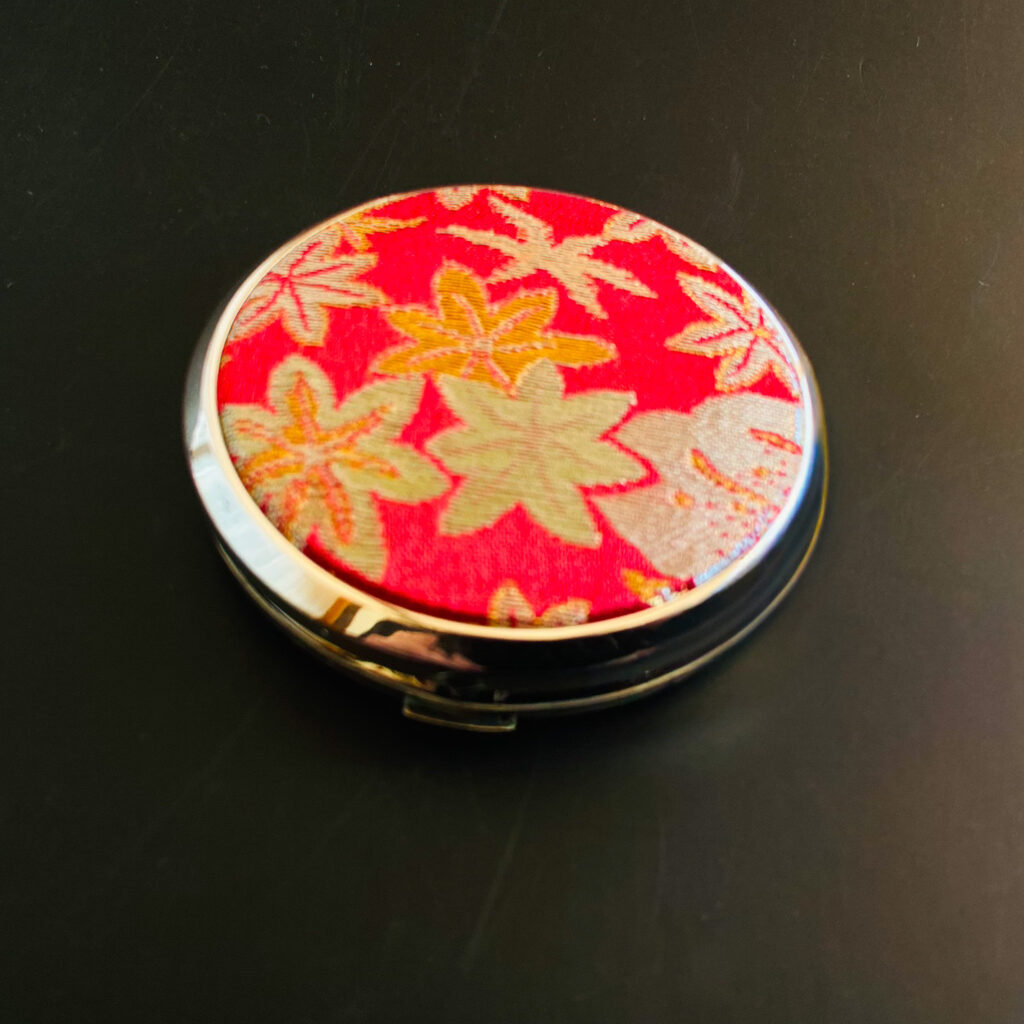
The first impression is the red.
Nishijin weaving was originally developed for obi sashes, meant to move with the body. Here, however, it is contained within a circle of about seven centimeters.
The shift in scale changes everything.
Instead of flowing across fabric, the maple motifs are compressed into a defined surface. The composition becomes more deliberate. The gold threads do not glare; they settle slightly into the weave, held by its texture.
Because it is cut into a circle, the pattern cannot expand endlessly. It must resolve itself within the edge of metal. That restraint gives the piece its quiet order.
Woven textiles usually carry a sense of movement and drape. On the lid of a compact, they become a pure decorative plane.
It is in this transformation that the interest lies.
The red appears bold at first, yet the longer one looks, the more the structure of the weave emerges. What remains is not brightness, but balance.
コメントを残す